
What are those brown boards?
Usually they are chipboard: the inner face of prefabricated roof elements, or separate boards fixed to the roof structure. In older homes they are brown, in newer ones often green or already primed white.
The boards belong to the roof. In roof elements they form one unit with the insulation behind them. They are therefore not something to simply take out; finishing normally means putting something over them.
Painting brown attic boards
Painting is possible and is the smallest job that makes an attic lighter. Chipboard soaks up paint, and untreated brown boards can discolour a light wall paint from underneath. That is why a stain-blocking primer goes on first, followed by the finishing coats.
The joints between the boards stay visible. A roof moves with temperature and wind, so a filled joint can crack open again. Many people therefore leave the joints visible on purpose or cover them with a slim batten.
- degrease, sand lightly and remove the dust
- a stain-blocking primer against bleed-through
- finish with wall paint in several coats
- leave the joints visible or cover them
Wallpaper or plaster on the boards
Lining paper over the boards can hide the joints, but the movement of the roof still acts on those joints. If it tears there later, that is hard to repair invisibly.
If you want a flat surface without visible joints, new boarding over the existing boards is the better route.
Lining with plasterboard or Agnes panels
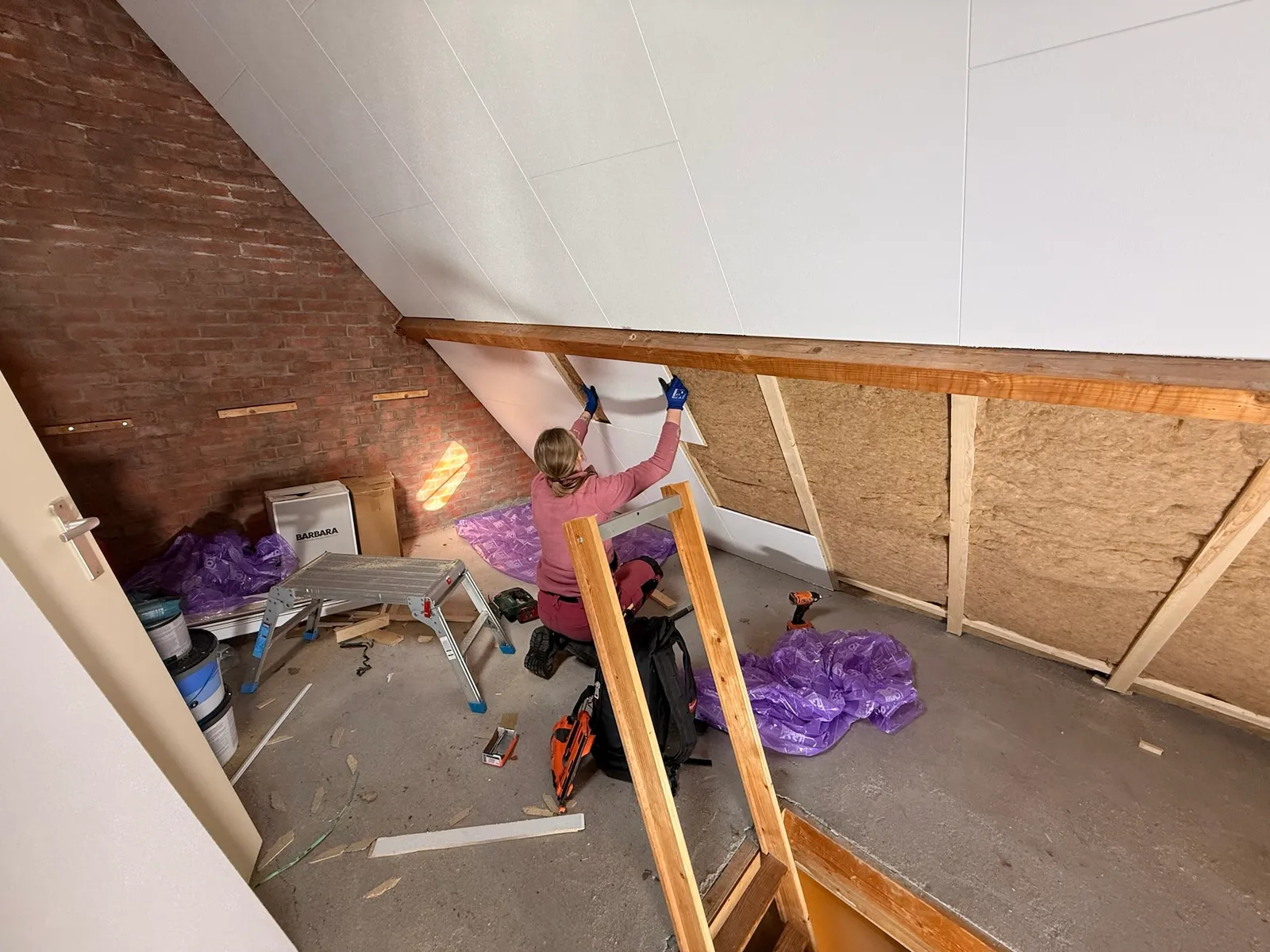
For a flat, light roof surface, new boarding goes over the brown boards, usually on battens. Plasterboard gives a surface that is then finished and painted. Agnes panels are finishing panels with a white face, which form the visible surface straight after fitting.
Battens take up unevenness and leave room for cables, lighting or an extra layer of insulation. They do take some space under the sloping roof.
- a flat roof surface without the old joints
- room for cables and lighting
- can be combined with extra insulation
- neat connections at the roof window, knee wall and ridge in one go
Look at insulation and moisture first
Behind older brown boards there is often only a thin layer of insulation. If you want to use the attic as a room, finishing combines well with insulating from the inside. That is easier before everything is closed up than afterwards.
Rings, dark patches or boards that feel soft or brittle can point to moisture. In that case find the cause first, such as a leak or condensation, before anything goes over them. A new finish does not solve a moisture problem.