
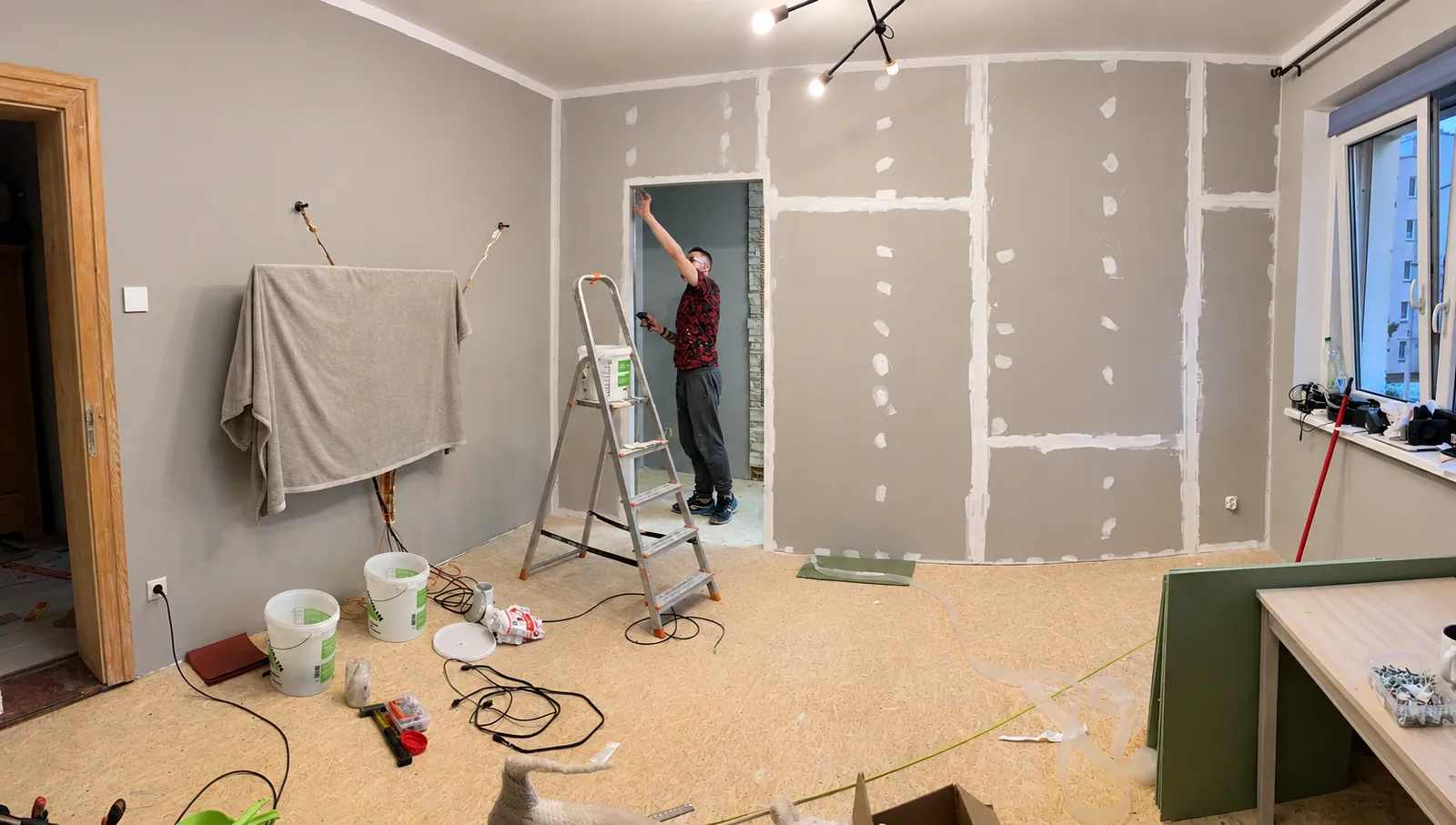
What do the terms mean?
The words describe a level of finish, not a material. A wallpaper-ready wall can be concrete, sand-lime brick, gypsum blocks or plasterboard; holes and joints are filled, but the surface is not yet smooth.
A paint-ready wall has a smooth finish without visible joints. Emulsion gives an even result on it. In Dutch new-build homes wallpaper-ready is common; paint-ready is often an optional extra.
- wallpaper-ready: flat, but with visible pits and joints
- paint-ready: smooth and suitable for painting directly
- sprayed finish: a grainy white coat, often on ceilings
How is a wallpaper-ready wall made suitable for paint?
There are two common routes. A plasterer can give the wall a smooth finish, making it paint-ready. Or the wall is lined with glass-fibre or renovation fleece, which is then painted; that hides small irregularities and hairline cracks.
Which route suits you depends on the substrate and on the look you want. Smooth plaster gives the sharpest result; fleece is more forgiving on walls that can still move, as in a new home.
Preparation decides the paintwork
A paint-ready or previously painted wall needs preparation too. Holes and cracks are filled and sanded, dust is removed and joints along the ceiling, skirting and frames are sealed.
New and highly absorbent surfaces, such as plasterboard and fresh plaster, get a primer first. Without primer the paint soaks into the wall unevenly, leaving patches and streaks. New plaster also has to be thoroughly dry first.
Ceilings and sprayed finishes
Ceilings in Dutch new-build homes usually have a white sprayed finish with a fine grain. It can stay as it is. If you later want a different colour or a fresh coat, bear in mind that a sprayed finish is delicate and absorbs a lot of paint.
On existing ceilings we look for discolouration from moisture or smoke. Such stains show through ordinary emulsion and need a stain-blocking coat first. We only treat a damp patch once its cause has been resolved.
Paint, coats and colour
For most walls and ceilings matt emulsion is the logical choice: it hides irregularities best. In a kitchen, hallway or child’s bedroom a more washable emulsion is often sensible.
How many coats are needed depends on the surface and the colour. A dark colour on a light wall, or the other way round, usually takes an extra coat. We agree that beforehand, so it is clear what the job includes.