
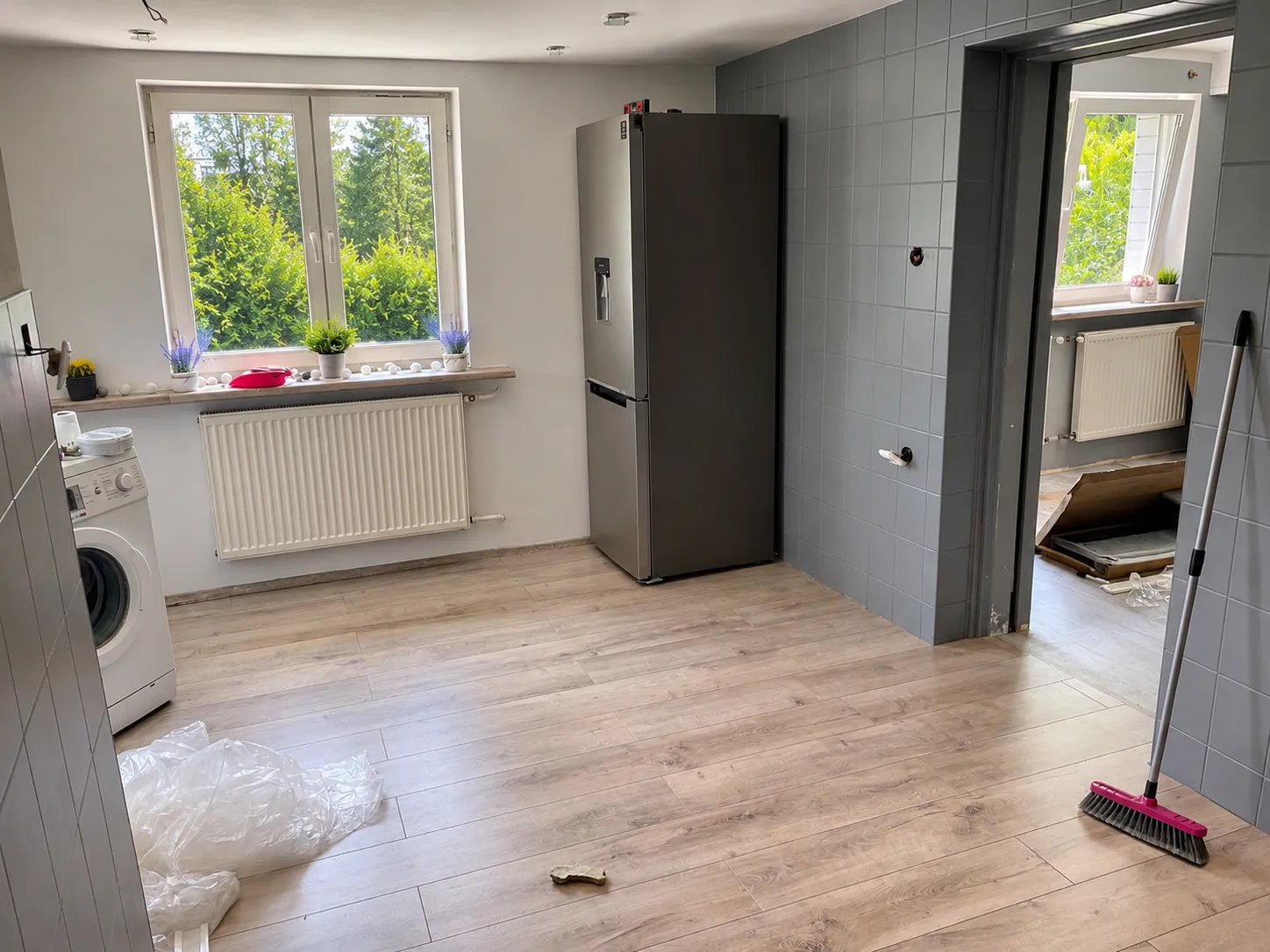
The main differences
Laminate is a hard wood-fibre board with a decorative layer and a wear-resistant top layer. It is scratch-resistant and sturdy, but the joints are sensitive to standing water.
Click PVC is a vinyl floor with a click system. The plank itself does not absorb water, feels warmer and sounds more muted when you walk on it. Versions with a rigid core hold their shape better than flexible planks.
- laminate: hard, scratch-resistant and often thicker
- click PVC: thin, moisture-tolerant and quiet
- both: laid floating on an underlay, without adhesive
Which room, and how is it used?
Both floors suit living rooms and bedrooms. In a kitchen, hallway or utility room, where wet shoes and spills are more common, click PVC is usually the safer choice.
With strong sunlight behind glass, a vinyl floor can expand more. We then look at the type of plank and leave enough room along the edges. A bathroom needs a different build-up and is not part of our work.
The subfloor decides the result
A click floor follows the floor beneath it. If that is not level, joints start to move and click connections can break. Thin PVC planks are more sensitive to this than laminate.
So we look at the subfloor first: concrete, screed, timber or sheet material. A new screed has to be dry enough before a floor can go on it. If the subfloor is very uneven, it has to be levelled first.
Underfloor heating and underlay
With underfloor heating, the heat has to pass through the floor. A thin floor on an underlay made for the purpose lets heat through better than a thick build-up. Click PVC often has the advantage here, but suitable laminate exists too.
The manufacturer specifies which underlay goes with the floor and how the underfloor heating should be turned up and down around the laying. We follow those instructions, because the manufacturer sets them as a condition.
Sound, especially in an apartment
A hard floor passes on more impact sound than carpet. The underlay largely decides how much the neighbours below hear.
In an apartment the owners’ association (VvE) often sets requirements for the sound insulation of a hard floor. Check the house rules or the deed of division before you choose a floor, and pass those requirements on to us.